Follow us on Twitter https://twitter.com/RainGarden6 @RainGarden6
Last updated on 10-July-2023.
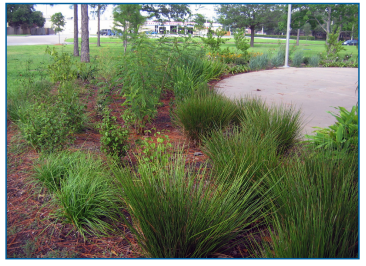
The soil cleans the water of pollutants before it enters the storm drain and empties into our bayous and bays. This process allows us to keep more of the rain that falls on our yards, and the storm water that finally enters the storm drain is cleaner.
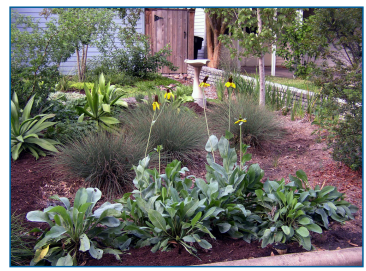
Another benefit is that rain gardens serve as habitats for wildlife such as birds and butterflies. They are useful for residential, commercial, and public areas.
Above all, a rain garden is a landscape amenity, blending beauty and function—an attractive WaterSmart solution to water pollution.
URL: https://agrilifeextension.tamu.edu/library/gardening/rain-gardens/
Download a printer-friendly version of this publication: https://cdn-ext.agnet.tamu.edu/wp-content/uploads/2018/10/ERPT-008-rain-gardens-a-beautiful-solution-to-water-pollution.pdf

Rain gardens or bioretention areas are designed to capture stormwater runoff, filter it through a special media and allow it to infiltrate, evapotranspire or flow out. Rain gardens consist of excavated basins equipped with a perforated pie underdrain. The underdrain is covered by a special soil- compost media in which specific vegetation is planted.

Proposed to be constructed in the southern portion of the AgriLife Campus the rain garden will have curb openings with a concrete flume that will allow for runoff to drain to a collection point within the garden for automatic sampling and flow measurement. A surface overflow box will drain water to an underground pipe away from the median. Additionally, the drainage layer of the rain garden will house perforated pipes that will assist in soil infiltration.
A flow measurement device will measure the overflow and perforated pipe. Water quality samples will be collected with an automatic sampler. A pressure transducer will be installed within a well point to measure soil water storage. The outflow will drain into a depression/ ditch via a flume.
Plants will be selected based on optimal performance of the rain garden, including treatment of the storm water. Overall, the monitoring data will be used to quantify total water inflow (runoff), outflow (runoff and infiltration), soil water storage, and pollutant balances. The rain garden will also be maintained beyond the scope of this project as a demonstration for the public.
Frequently Asked Questions
Source: https://www.alidp.org/assets/pdfs/rain_garden_booklet-calgary.pdf
https://www.alidp.org/assets/pdfs/CRAG_RAIN_GARDENS.pdf
https://alidp.org/events-and-education/the-lid-toolbox/tools-for-achieving-lower-impact/rain-gardens
What is a rain garden?
What is rain garden?
A rain garden is a beautiful and effective way to clean polluted stormwater runoff. A rain garden acts like a miniature native forest by collecting, absorbing, and filtering stormwater runoff from roof tops, driveways, patios, and other areas that don’t allow water to soak in. They can be built at several scales and one may be just right for your home or neighborhood.
Rain Gardens are simply shallow depressions that:
# Can be shaped and sized to fit your yard.
# Use a special mix of sand and compost that allow water to soak in
rapidly and supports healthy plant growth.
#Can be landscaped with a variety of plants to fit the surroundings.
Will it be expensive or difficult to install and maintain a rain garden?
Once a shallow depression is dug for the rain garden, it won’t be any more expensive than planting other landscaped areas in your yard. Most of the
recommended plants can be purchased at local nurseries and you maintain them just like any other plants in your yard. If you are using native plants,
once established, they will require less water and no fertilization.
Won’t a rain garden create a pond for mosquitoes?
No, a rain garden is not a pond. When properly constructed, the water will drain within 48 hours (but usually faster). Mosquitoes won’t find rain gardens to be good breeding areas because they need much more time to lay and hatch eggs.
I’m interested in building a rain garden. What should I do next?
Visit http://www.cmhc.ca (or any equivalent website in your area) and type “rain gardens” in the search field for more information on rain gardens.
*Note: This information is provided for your benefit only. If you do not feel comfortable in constructing your rain garden, please consult a landscaper.
The City of Calgary will not be liable nor responsible for any bodily or
personal injury or property damage of any nature that may be suffered
from the construction of your rain garden.
What’s are Benefits of Rain Gardens
Low maintenance. Rain gardens need no more care than regular landscaping.
Grows quickly. Extra moisture and loose, deep soil make plants thrive and quickly fill in a space.
Provides habitat. Rain gardens can provide abundant food, water, and shelter for wildlife such as birds and butterflies.
Diversifies plant possibilities. Extra natural moisture means you can have a water-wise garden while including more moisture-loving plants you might otherwise have had to leave out.
Improves aesthetics. Rain gardens add visual interest to your yard and your community.
Why Rain Gardens are Best for…
Properties with more space. Rain gardens are simplest to install when you can stay at least three metres away from building foundations.
Newer properties with mostly manicured turf. Typical groomed turf is usually underlain with a shallow soil that is inhospitable to plant survival, doesn’t break down contaminants, and creates a lot of runoff. Adding rain gardens to this type of property (newer than about 1970) will instantly improve its performance.
Areas where a tree canopy is yet to establish. If you have mature trees, your property is working hard already, and rain gardens are a type of feature that might be difficult to fit in. Where you don’t have trees, rain gardens are a major performance booster.
Rain Garden Basics
What is a rain garden?
A rain garden is a beautiful and effective way to clean polluted stormwater runoff. A rain garden acts like a miniature native forest by collecting, absorbing, and filtering stormwater runoff from roof tops, driveways, patios, and other areas that don’t allow water to soak in. They can be built at several scales and one may be just right for your home or neighborhood.
Rain Gardens are simply shallow depressions that:
- Can be shaped and sized to fit your yard.
- Use a special mix of sand and compost that allow water to soak in rapidly and supports healthy plant growth.
- Can be landscaped with a variety of plants to fit the surroundings.
Why do we need raingardens? Stormwater is nothing but rainfall after it falls on the earth’s surface and travels across the landscape to a nearby stream or other water body. In landscapes that have been altered by humans, this stormwater picks up everything we humans leave behind – things like oil and gas, heavy metals, fertilizers, and animal waste.
Scientists have confirmed that stormwater is harmful to humans, animals, and fish that come in contact with it. Eventually stormwater makes its way to Puget Sound impairing the Sound’s water quality, impacting our shellfish and fisheries industry, and limiting recreational opportunities. (Source: https://extension.wsu.edu/raingarden/featured-rain-gardens/)
WSU research and experiments have shown that stormwater collected from highways around Puget Sound is lethal to fish. However, when that same stormwater was filtered through a special rain garden soil mix – the fish lived. Rain gardens can be a important tool in limiting the amount of contaminated water reaching our streams and Puget Sound.
Raingarden – A clean solution to storm water pollution.

1. Pick the Right Location and Size
The best locations are in natural depressions or low lying areas where water flows naturally from a downspout, driveway, patio or sidewalk. Avoid steep slopes and areas near septic systems or drinking water wells. You must be able to move water from the hard surface (roof, etc.) to the garden location, either by directing a downspout with an extended tube towards it, or simply by following contours and capturing water that is naturally flowing downhill.
Click here for more detailed information about picking the right location

A properly sited and prepared rain garden will not allow mosquitoes to breed. Your rain garden will drain within 24-48 hours after a storm. Mosquitoes need seven days or more to complete a breeding cycle
2. Create a Design and Select Plants
Once you have a location and size for your garden, sketch it out on paper. Determine the mix of species you would like to use, including flowers, grasses, and shrubs that are drought tolerant but can withstand wet conditions. Native plants are adapted to local conditions, easy to maintain and attract birds and butterflies. Fill in your sketch with your selected plants. Click here for more detailed information about design and plant selection .
3. Construct and Plant your Garden
Spray paint or otherwise mark on the ground the exact shape of your rain garden. Excavate to a depth of 4-8 inches, creating a berm on the downslope side of your garden using the removed sod. Amend your soil as needed to improve drainage. Try to keep the bottom of the basin as flat as possible to increase the area that will come in contact with water regularly. Add plants following your design, placing species that need the most water in the lowest lying areas or in the most direct path from the downspout. Click here for more detailed information about constructing and planting your rain garden .
4. Rain Garden Plants

By using native plants in your rain garden you are giving your plants the best chance to survive the wide range of weather conditions they will experience, from long droughts to large storms. Native plants also support the largest number of wildlife species, including birds, butterflies, and bees.
Click here for more detailed information about selecting the right plants
















 Raincentre's Blog