‘Japanese have been producing wood for 700 years, without cutting down trees’
‘Japanese have been producing wood for 700 years, without cutting down trees’ :
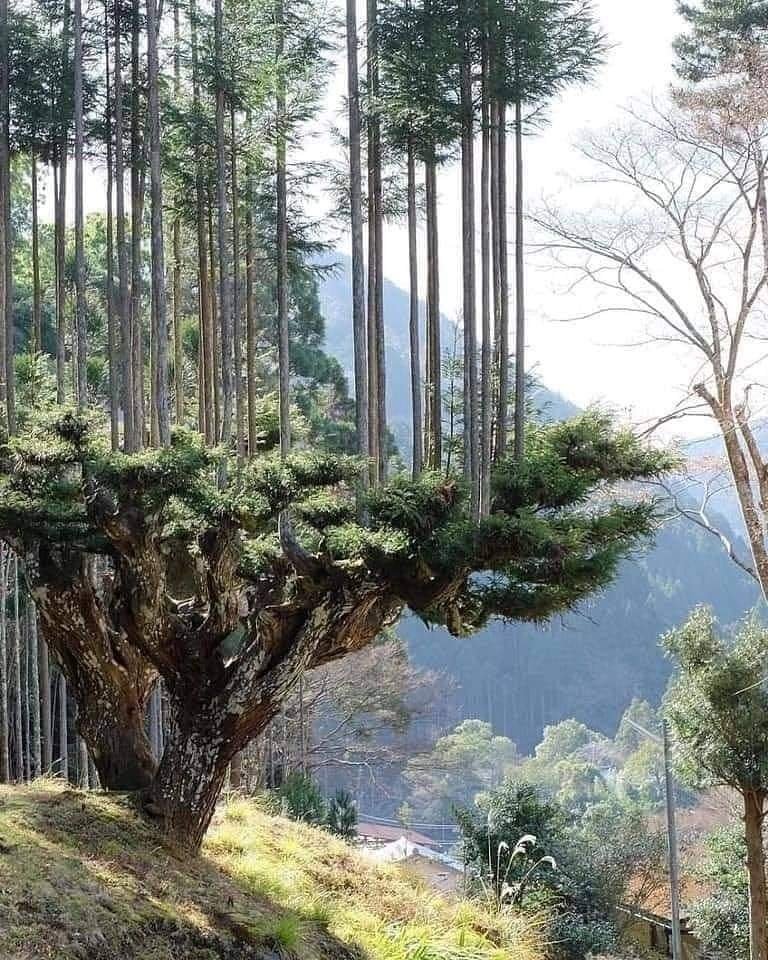
In 14th Century CE, ‘Daisugi’ technique was born in Japan. Daisugi provide that these trees will be planted for future generations and not be cut down but pruned as if they were giant bonsai trees.
By applying this technique to cedars, wood that can be obtained is uniform, straight and without knots, perfect for construction. A pruning as a rule of art that allows tree to grow and germinate while using its wood, without ever cutting it down.
‘Japanese have been producing wood for 700 years, without cutting down trees’
Due to its flexibility and durability over other types of wood, aisugi type wood has great demand in the market. The Japanese have been producing wood for 700 years without cutting down trees. In the 14th century, the extraordinary daisugi technique was born in Japan.
Do Japanese produce wood without cutting down trees?
The method originated in Kyoto and involves pruning the branches of Kitayama cedar so that the remaining shoots grow straight upward from a platform. Rather than harvesting the entire tree for lumber, loggers can fell just the upper portions, leaving the base and root structure intact.
Japan is an intriguing country (especially for an outsider) that never ceases to amaze and inspire people by striving for perfection. It appears that the pursuit of excellence is something that’s deeply embedded in the culture, and it shows in different areas of life and various ways.
The majority of us are already familiar with the concept of bonsai—a Japanese art form dating back over a thousand years, which produces small trees that mimic the appearance of full-size trees. But many still haven’t heard about daisugi. While its technique has similarities to that of bonsai, the result it produces is vastly different.
Literally translating to platform cedar, daisugi is a 14th- or 15th-century technique that offers an efficient, sustainable, and visually stunning approach to forestry. The method originated in Kyoto and involves pruning the branches of Kitayama cedar so that the remaining shoots grow straight upward from a platform. Rather than harvesting the entire tree for lumber, loggers can fell just the upper portions, leaving the base and root structure intact.
Although daisugi mostly is used in gardens or bonsai today, it originally was developed to combat a seedling shortage when the demand for taruki, a type of impeccably straight and knot-free lumber, was high. Because the upper shoots of Kitayama cedar can be felled every 20 years, which is far sooner than with other methods, the technique grew in popularity.
 Raincentre's Blog