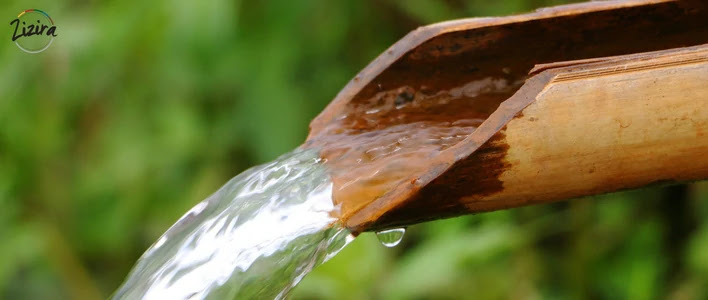
As you may already know, the topography in Meghalaya is hilly, with steep slopes and rough landscapes. Hence, using ground channels in this area is unfavorable. So, bamboo drip irrigation is widely preferred.
Usually, water sources are distant from plantation sites and so the main bamboo channel runs several meters, sometimes even a couple of kilometres. Water is thus obtained and managed through a brilliant bamboo system of secondary and tertiary channels to reach each part and corners of the plantation.
Bamboo channels are utilized to tap perennial water from up-slopes, which is cleverly diverted to the lower parts using gravity. An ingenious system that wastes very little water and works to this day.
Channel sections are made of bamboos of different diameters, to control the water flow in such a way that the water reaches the site in the lower reaches, where it is circulated without spillage. The channels are supported by forked branches.

It is so perfected that about 18-20 litres of water entering the bamboo pipe system per minute gets transported over several hundred metres and finally gets reduced to 20-80 drops per minute at the site of the plant.
One must see it to appreciate the intricacy and the smartness of the system. It is estimated that even up to 20 liters of water flows into the channel every minute. Have you ever heard of this type of irrigation before? Read the story at Zizira website: https://www.zizira.com/blogs/people-and-process/bamboo-drip-irrigation-meghalayas-native-farmers
https://www.facebook.com/ZiziraHealthyProducts/videos/bamboo-drip-irrigation/729628701280465/
About Zizira: https://www.zizira.com/pages/our-story
Additional Reading:
http://www.cpreecenvis.nic.in/Database/BamboodripIrrigation_3767.aspx
https://www.cseindia.org/bamboo-drip-irrigation-2839
http://www.rainwaterharvesting.org/methods/traditional/bamboo.htm
One can buy online best quality herbs and spices that are grown in traditional ways by Meghalaya’s farmers (without pesticide and chemicals fertilizer) and are unadulterated and guaranteed by Zizira from their website https://www.zizira.com/ .
A Report on The Agricultural Potential of Meghalaya https://explorers.zizira.com/meghalaya-potential-of-the-land-ebook/
Traditional Farming Methods practiced by Meghalaya https://www.zizira.com/blogs/people-and-process/bamboo-drip-irrigation-meghalayas-native-farmers

Most Farmers Traditional Farming Methods
Over 80% of the population of Meghalaya depend on agriculture and most of them own small family farms and follow traditional farming methods. A good irrigation system is an imperative for successful farming.
Read on to see how these farmers who follow traditional farming methods have a traditional irrigation system designed by themselves.
A 200 years old Traditional Irrigation System
The topography in Meghalaya is hilly, with steep slopes due to which there are two challenges the farmers of Meghalaya face.
First, the water-retention capacity of the terrain is poor.
Second, bringing water from distant water sources to the fields is a big challenge for the farmers in the rural areas.
Ground channeling is also impractical due to the harsh landscape. Confronted with such adverse conditions for irrigation, the traditional farmers of Meghalaya have come up with an innovative way that works. Since olden times, farmers of Meghalaya who mostly follow traditional farming methods have been utilizing an indigenous, traditional irrigation method of bamboo drip irrigation system to water their crops.
The few materials needed are a locally made small axe (local name – dao), bamboo strands of various sizes, forked branches, smaller bamboo shoots used for the channel diversions, and two trained laborers. Two workers can construct a system covering one hectare of land in 15 days. About four or five stages of irrigation zig-zag from the water source to the last point of application. Along the way, 18-20 liters of water will eventually disseminate at a rate of 20-80 drops per minute.
The people of Jaintia, Khasi, and Garo hill tribes of Northeast have long entrusted the use of bamboo drip irrigation as a means to fulfilling domestic, agricultural, and customary needs. Its function remains unspoiled so as the rains continue to fall and the bamboo continues to grow.
Further reading: https://www.zizira.com/blogs/people-and-process/bamboo-drip-irrigation-meghalayas-native-farmers
Last updated on August 27, 2023.
 Raincentre's Blog