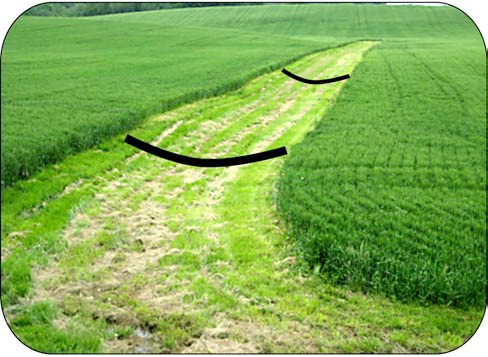
Grassed waterways are fundamental in reducing erosion and impacting water quality.
What is a Grassed Waterways? A grassed waterway is a natural or constructed channel that is shaped or graded to required dimensions and established with suitable vegetation.
Grassed waterways are used to convey runoff from concentrated flow without causing soil erosion, to control gully erosion, and/or to protect and improve water quality. Depending on the type of vegetation established, grassed waterways may also provide wildlife habitat for a variety of “farmland” wildlife such as quail, pheasants, and rabbits.
What is it? A grassed waterway is a constructed grade channel seeded to grass or other suitable vegetation. The vegetation slows the water, and the waterway conveys the water to a stable outlet at a nonerosive velocity. A grassed waterway is considered an in-field practice.
Where it is used? A grassed waterway is usually used in the natural waterways of a field, where concentrated flows of surface water left unchecked will form gullies. The waterway is designed to slow and channel water, providing vegetated cover to prevent erosion. Grassed waterways are often located in large fields and can collect water from upslope areas in multiple fields.
To get a government rebate – contact your local authority and check your eligibility criteria.
ELIGIBILITY – To be eligible for this practice for the Conservation Reserve Program (CRP), the land must have a cropping history (4 out of 6 years from 1996 – 2001), and a grassed waterway must be able to address the resource concern.
Learn to properly size and construct, grassed waterways to safely transport water through farm fields.
Grass Waterways: Tips and Tricks for Maintenance and Function:
Grassed waterways are fundamental in reducing erosion and impacting water quality:
Further Readings: “Soil and Water Conservation Allen County” https://rainwater.blog/2022/02/14/soil-and-water-conservation-allen-county/
 Raincentre's Blog